


News and Articles
What is Data Center Modernization? And Why Is It a Key Strategy for Modern Data Centers in the AI Era?
07 April 2026
In an era where Artificial Intelligence (AI) and Digital Transformation have become critical drivers of business competitiveness, organizations’ IT infrastructure is being increasingly challenged. At the center of this transformation lies the Data Center the core hub for data storage and business system processing.
However, many organizations today are still operating Traditional Data Centers that were designed years ago. These legacy infrastructures may not be able to efficiently support modern workloads such as AI processing, Big Data analytics, cloud-native applications, or hybrid IT environments.
As a result, Data Center Modernization has become one of the most important strategic initiatives for modern enterprises.
The key question for business leaders today is:
“Is your organization ready to modernize its data center to support business in the AI economy?”
In this Metro Strategic Column, we explore 7 key aspects of Data Center Modernization that modern organizations should consider.
1. What is Data Center Modernization?
Data Center Modernization refers to the process of upgrading and transforming data center infrastructure to support modern technologies and workloads such as:
- Artificial Intelligence (AI)
- Machine Learning
- Big Data Analytics
- Cloud Computing
- Hybrid IT Infrastructure
Modernizing a data center does not necessarily mean replacing the entire system. Instead, it involves redesigning IT infrastructure to become more flexible, scalable, and adaptable to future business changes.
The key objectives of a modern data center include:
- Enhancing data processing capabilities
- Supporting hybrid cloud infrastructure
- Improving system security
- Reducing long-term IT costs
- Increasing agility for digital service development
2. Key Components of a Modern Data Center
Organizations planning a Data Center Modernization initiative should upgrade several infrastructure components to build a Modern Data Center Architecture.
2.1 Software-Defined Infrastructure
Modern data centers are shifting from Hardware-Centric management toward Software-Defined Infrastructure (SDI), where systems are controlled and managed through software.
This approach enables organizations to:
- Manage IT resources more efficiently
- Reduce manual operational tasks
2.2 Hybrid Cloud Infrastructure
One of the key approaches in Data Center Modernization is implementing a Hybrid Cloud Infrastructure, which combines:
- On-Premise Data Centers
- Public Cloud
- Private Cloud
This allows organizations to leverage the strengths of each environment. For example:
- Storing sensitive data on-premise
- Using the cloud for scalable workloads
- Running AI or big data analytics in the cloud
Hybrid cloud infrastructure enables organizations to:
- Increase operational flexibility
- Reduce infrastructure costs
- Scale systems rapidly
2.3 Modern Cybersecurity Architecture
As cybersecurity threats become increasingly sophisticated, modern data centers must adopt advanced security architectures such as:
- Zero Trust Security
- Micro-segmentation
- AI-driven threat detection
- Identity and Access Management (IAM)
These approaches help reduce cyberattack risks and protect critical organizational data.
3. Why Organizations Need Data Center Modernization?
Many organizations are beginning to realize that traditional data centers can no longer support modern business demands. Several key reasons drive the need for modernization.
3.1 Supporting AI and Data Analytics
AI workloads require infrastructure capable of supporting:
- High-performance computing
- High-throughput storage
- Low-latency networking
Most traditional data centers were not designed to efficiently support these requirements. Therefore, modern data center infrastructure has become essential for organizations looking to develop AI platforms and data-driven applications.
3.2 Increasing Business Agility
Digital businesses require systems that can:
- Deploy applications quickly
- Scale infrastructure instantly
- Support DevOps and cloud-native applications
Data Center Modernization enables organizations to accelerate digital service development and respond more effectively to market changes.
3.3 Reducing Long-Term IT Costs
Although modernizing a data center requires upfront investment, it can significantly reduce long-term costs, including:
- Hardware costs
- Energy consumption
- Maintenance costs
- Operational manpower
3.4 Enhancing System Security
Modern data centers are designed to support advanced security architectures such as:
- Zero Trust Security
- Advanced threat detection
- Security automation
These capabilities significantly improve the protection of enterprise data and IT systems.
4. On-Premise vs Cloud vs Hybrid Infrastructure
When organizations begin planning a Data Center Modernization strategy, one of the most important questions is: Which infrastructure model should be chosen?
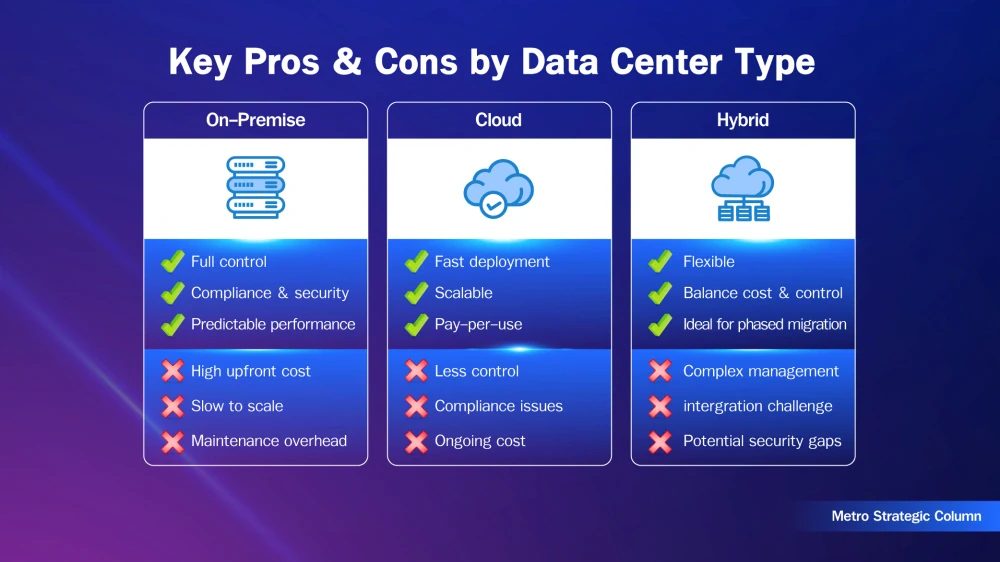
4.1 On-Premise Data Center
On-premise infrastructure refers to systems where organizations own and operate all hardware and manage their own data centers.
Advantages
- Full system control
- Stable infrastructure
- High data security, suitable for organizations with sensitive data or strict compliance requirements
Limitations
- High hardware investment
- Slower scalability
- Requires dedicated IT teams
4.2 Cloud Infrastructure
Cloud infrastructure refers to using IT resources provided by cloud service providers.
Advantages
- Rapid deployment
- Fast scalability
- Pay-as-you-use pricing
Limitations
- Limited control over infrastructure
- Compliance considerations
- Ongoing operational costs
4.3 Hybrid Cloud Infrastructure
Hybrid cloud has become the most widely adopted approach today because it allows organizations to combine the strengths of both on-premise and cloud environments.
For workloads requiring scalability, hybrid cloud provides the right balance between security, flexibility, and infrastructure cost efficiency.
Advantages
- High flexibility
- Greater control over systems and costs
- Suitable for workload and data migration
Limitations
- More complex management
- Challenges in data integration
- Potential security gaps if not properly managed
5. Key Factors Executives Should Consider Before Modernizing a Data Center
Before launching a Data Center Modernization project, executives should carefully evaluate several important factors.
5.1 Data Security
Organizations must assess the sensitivity of their data and implement appropriate security measures.
5.2 Business Continuity
Infrastructure should support business continuity mechanisms such as:
- Backup systems
- Disaster Recovery
- High Availability
These capabilities ensure that business operations can continue even during unexpected disruptions.
5.3 Scalability
A modern data center must be able to scale infrastructure quickly to support business growth and changing operational demands.
5.4 Long-Term Cost Management
Investment in IT infrastructure should consider the total financial impact, including:
- CAPEX
- OPEX
- Migration costs
- Operational expenses
This helps organizations achieve an optimal Total Cost of Ownership (TCO).
6. When Should Organizations Start Modernizing Their Data Centers?
Organizations should consider data center modernization when:
- Existing infrastructure cannot support new workloads
- The organization plans to implement AI or big data analytics
- Greater system scalability is required
- There is a need to reduce long-term IT costs
7. Challenges of Data Center Modernization
Despite its benefits, many organizations still face challenges when modernizing their data centers, such as:
- Complex legacy infrastructure
- Workload migration difficulties
- Lack of architecture expertise
For this reason, many organizations choose to work with experienced technology partners.
MetroSystems: A Trusted Partner for Data Center Modernization
Building a modern data center infrastructure requires expertise in:
- Technology implementation
- Infrastructure architecture design
- System integration
Metro Systems Corporation is one of Thailand’s leading IT infrastructure solution providers with extensive experience helping large organizations design and modernize their data centers.
MetroSystems’ services include:
- Data Center Infrastructure Design
- Hybrid Cloud Infrastructure
- Cybersecurity Architecture
- AI-ready Infrastructure
- Managed IT Services
Our team of experts can help your organization:
- Assess current infrastructure
- Design modern architecture
- Develop a roadmap for digital transformation
Contact us today to ensure your data center is ready to support business in the AI era.
For organizations planning to modernize their data centers in the AI economy, IT infrastructure is no longer just a support system for business operations. It has become a critical platform for building competitive advantage. Partnering with an experienced technology provider like Metro Systems Corporation can help reduce risks while enabling sustainable business growth in the AI-driven digital economy.