


News and Articles
4 Organization Cyber Threat Cases and 3 Risk Point yo Inspect
17 November 2026
“If the monitor shows that the cold storage temperature is normal while products are actually spoiling because a hacker manipulated the thermostat—or if funds are transferred out of customer accounts in the middle of the night—who will know first, and who has the authority to stop the damage?”
Cyberattacks occurring between October and early November 2026 demonstrate that an anomaly in a single system can cascade into disrupted product deliveries, compromised customer data held by partners, financial theft, and severe threats to Business Continuity. While the following four cases began differently, they all compel organizations to ask the exact same question: When an incident strikes, how quickly can we detect it and take action?
4 Incidents Reflecting the Business Impact of Cyber Threats
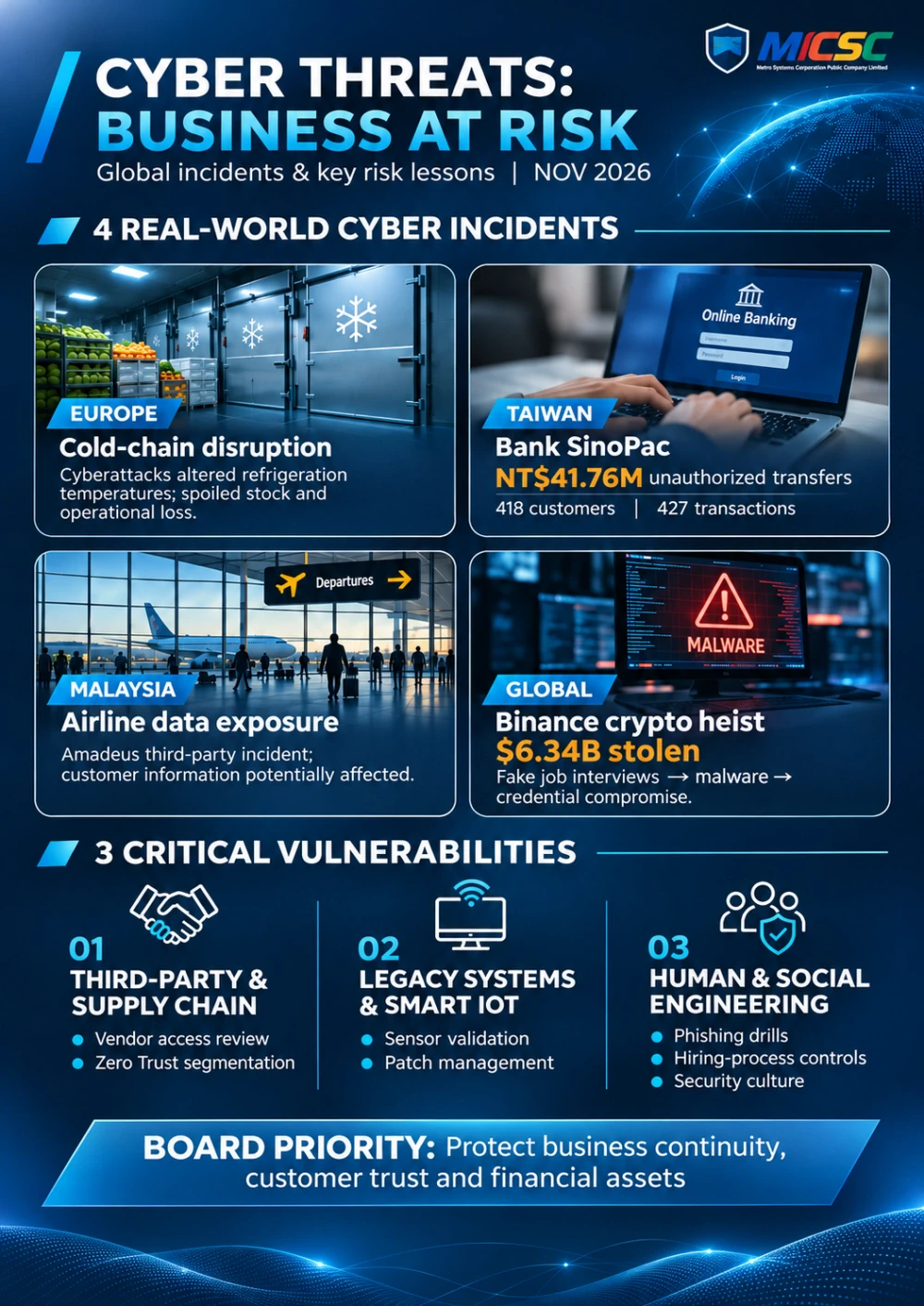
Europe | Cooling Systems Hacked, Forcing Massive Product Disposal Reuters reported that cyberattacks targeting refrigeration systems affected retail stores across several European countries, forcing retailers to discard massive quantities of food. Around the same time, the French Ministry of Health disclosed that a cyber incident impacted monitoring and control systems for cold storage units at certain blood storage facilities. For businesses relying on temperature-controlled supply chains (Cold Chain), any disruption to control systems directly threatens both product integrity and delivery schedules.
Malaysia | Customer Data Potentially Exposed via Third-Party Systems Malaysia Airlines issued an advisory warning that a cyber incident involving Amadeus, its reservation technology provider, may have affected certain customer data processed through the vendor’s platform. While the airline confirmed its own IT systems remained secure and stated there was no evidence of financial data exposure at the time of the announcement, the incident serves as a crucial lesson. Organizations must audit where customer data is sent for processing and verify how third-party vendors notify them during an emergency.
Taiwan | New System Security Misconfiguration Linked to Unauthorized Transfers On November 3, 2026, Bank SinoPac detected 427 unauthorized fund transfers totaling over NT$42 million. The bank stated the breach stemmed from security misconfigurations in a newly launched online banking system developed by a third-party vendor. Upon discovery, the bank immediately suspended the new application, reverted customers to the previous version, and launched an investigation. This case underscores the necessity of rigorous pre-launch security testing and maintaining robust rollback plans to ensure uninterrupted customer service.
Digital Assets | Fake Job Interviews Used as an Entry Point for Theft Reuters reported that Binance suffered a digital asset theft valued at approximately US$6.3 billion, originating from a "fake job interview" used by attackers to compromise an engineer’s workstation. Because outreach from recruiters is a routine part of modern professional life, threat actors exploited this familiarity to execute a sophisticated Social Engineering attack.
3 Cybersecurity Vulnerabilities Organizations Should Audit
Modern cyber threats do not merely target systems through direct technical breaches; they frequently exploit everyday operational gaps. Here are three critical questions organizations should review to close security loopholes before damage occurs:
- How Much Access Do Vendors and Outsource Teams Have?
Granting external parties system access without strict governance is a top-tier risk. Organizations should start by maintaining a clear inventory of all third-party vendors with access to critical systems or data—documenting why they need access and who approved it. Next, implement Zero Trust Segmentation to isolate networks and enforce least-privilege access, alongside thorough configuration audits before going live—especially for transaction systems and customer databases. Furthermore, adopting a Third-Party Risk Management (TPRM) framework helps standardize required security evidence and establish formal incident notification protocols with service providers.
- If Screen Data and Physical Reality Don't Match, Who Will Notice?
While automation and Smart Sensors enable real-time monitoring, manipulated dashboard data or faulty sensors can lull teams into a false sense of security while an on-site crisis unfolds. This is especially critical in strictly regulated sectors like food, pharmaceuticals, and medical supplies. Organizations must schedule routine physical inspections using measurement tools independent of the primary system (Independent Verification), supported by clear ownership and escalation procedures the moment a discrepancy is detected.
- How Prepared Are Employees to Handle Suspicious Outreach?
Preventing Social Engineering requires more than an annual training session; it must be embedded into company culture. Organizations should run realistic simulations mirroring daily workplace scenarios—such as unsolicited test files, prompts to install software, or credential verification links. Most importantly, employees must know how to verify requests through official channels and feel empowered to report mistakes to the IT team immediately—even if they have already clicked a link or opened a file—to contain potential damage as fast as possible.
How Metro Systems’ 24/7 SOC Service Protects Your Organization
Metro Systems Corporation (MSC) elevates your cyber defense with SOC Managed Services—providing 24/7 monitoring, threat analysis, and anomaly triage, backed by coordinated incident response aligned with your pre-established protocols. When an incident occurs outside business hours, your team gains immediate visibility, knows exactly which areas to prioritize, and understands who is responsible for each next step—minimizing risk and containing damage before it escalates.
Because mission-critical business systems cannot afford downtime—is your organization covered by 24/7 monitoring?
[Consult with Metro Systems’ Cybersecurity team today to assess your readiness.]