


News and Articles
The Risks of AI in Business: When “Speed” Comes at the Cost of “Decision Quality”
19 May 2026
AI is accelerating businesses faster than ever before. But the critical question is:
Is your organization gaining a competitive advantage — or unknowingly increasing its risks?
AI Makes Everything Faster… But Are We Still Thinking Critically?
Over the past few years, AI has rapidly transformed the way organizations operate — from summarizing reports, analyzing data, and writing code, to supporting critical business decisions. Many organizations are already seeing clear improvements in productivity, including faster operations, lower costs, and easier access to information than ever before. But the key question is:
“Is the increase in speed coming at the expense of the quality of thinking and decision-making?”
When AI Makes Us “Faster” but “Think Less”
The article If AI Can Do Everything, Why Learn Anything? highlights that while AI may improve short-term performance, continuous reliance on AI can gradually reduce deep understanding and critical thinking without users realizing it. People may begin to depend on AI-generated answers instead of conducting their own analysis. As a result, tasks may be completed faster, but the quality of decision-making could decline.
Research Confirmed: AI Boosts Productivity — But Also Increases Decision Risk
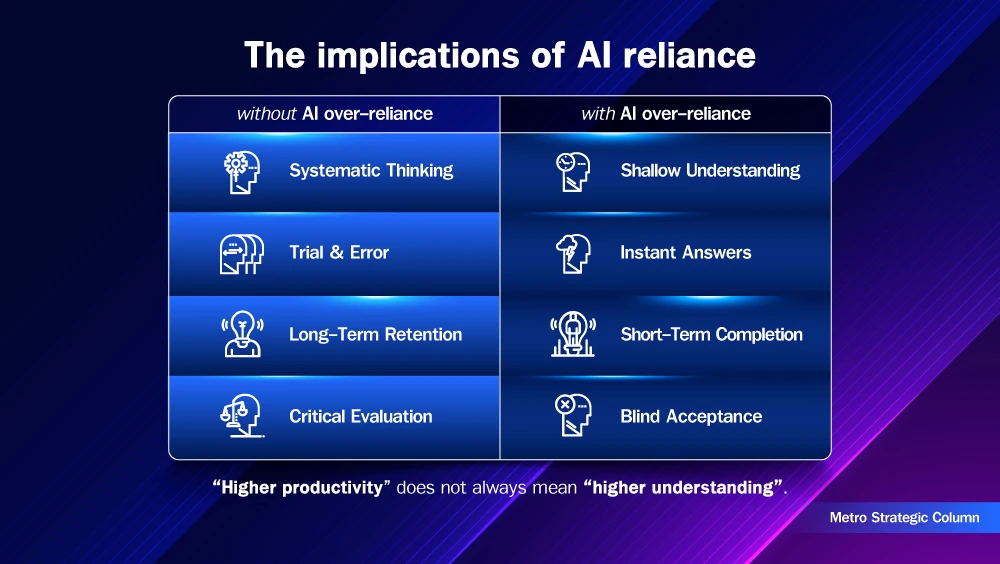
Research from The Cognitive Cost of AI published in Frontiers in Education (2024) found that: AI helps people work faster, but it also reduces deep thinking and cognitive processing. This means organizations may unknowingly be transforming “Productivity” into “Decision Risk.”
Risks Organizations Should Not Overlook
Although AI enables organizations to work more efficiently, using it without proper governance and skills can create significant business risks.
Reduced Decision Quality
When employees rely too heavily on AI without verifying information, questioning outputs, or applying critical thinking, decisions may be made faster — but with lower accuracy.
Skill Degeneration
Continuous AI dependency can weaken analytical thinking and problem-solving skills, ultimately affecting long-term competitiveness.
AI Governance and Compliance Risks
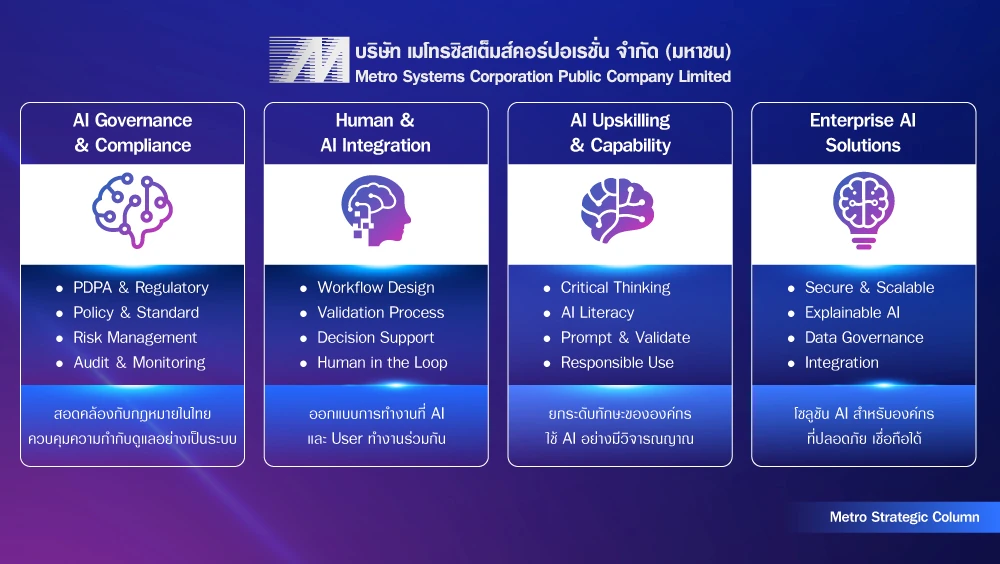
Using AI in business involves concerns related to PDPA, data governance, regulatory compliance, and cybersecurity. Without proper oversight, organizations may face legal issues, reputational damage, and operational risks.
The Most Dangerous Trap: Automation Bias
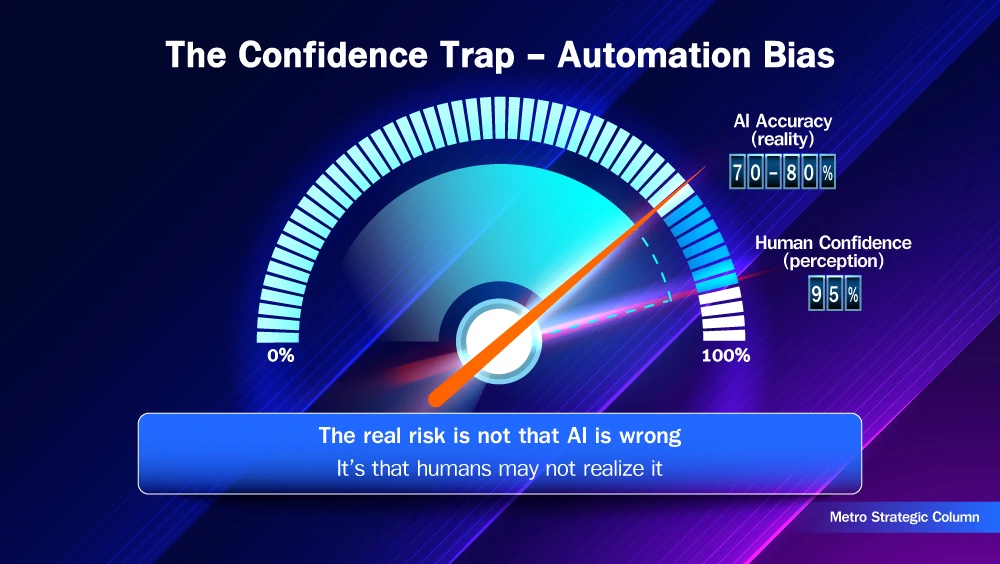
Psychological research on The Automation Bias Effect published in Frontiers in Psychology (2025) suggests that: Many users tend to trust AI-generated outputs even when the information is incorrect. When AI responses appear convincing and reliable, users are less likely to verify information or challenge the results. This creates a hidden organizational risk that can lead to poor business decisions at scale.
How Should Organizations Use AI Effectively?
The solution is not to stop using AI — but to use it correctly. Organizations must shift from simple “AI Usage” toward “AI Thinking.” In the AI era, organizations need critical capabilities such as: Critical thinking skills to question AI outputs. Validation skills to verify information before using it. Judgment skills to determine when AI should — or should not — be trusted. AI should be used as a tool, while humans remain the ultimate decision-makers.
Transform AI from a “Risk” into a “Competitive Advantage” with MSC
Metro Systems Corporation (MSC) helps organizations design AI adoption strategies that are both effective and secure.
In a world where every organization has access to AI, the real competitive advantage will belong to those who can think and make better decisions. Don’t let AI become an “invisible risk” to your organization.
Contact us today for AI risk assessment and AI governance consultation for your organization at Corporatedevelop@metrosystems.co.th or Contact us.
“Because customer success is our business.”