


News and Articles
10 Strategic Technology Trends Shaping the Future of Business in 2026 — by Gartner
03 November 2025
“As AI becomes a driving force across every enterprise, keeping up with technology trends is no longer the responsibility of developers alone — it’s a leadership imperative for executives and employees at every level to thrive in a digital-first world.”
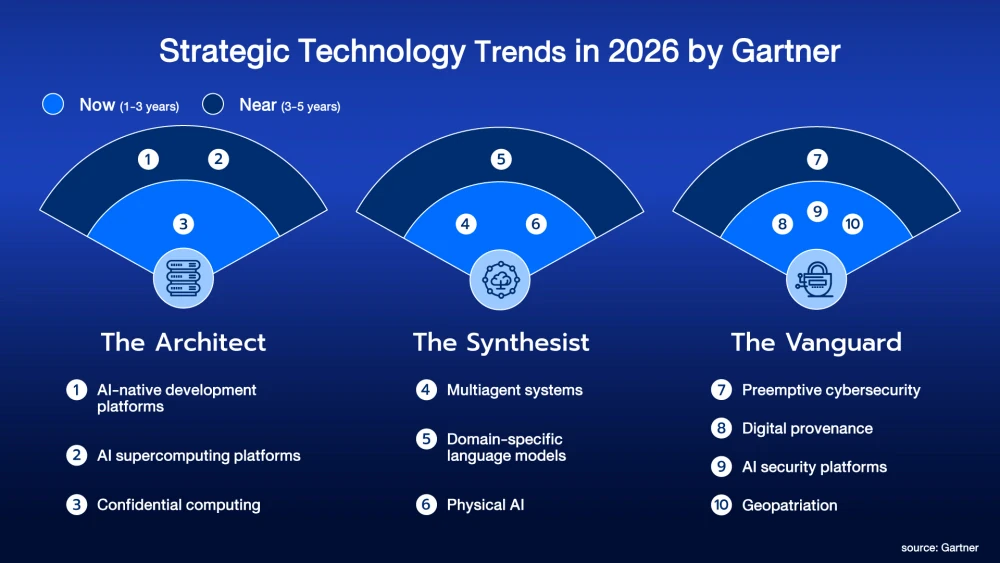
10 Strategic Technology Trends for 2026

🧱 The Architect: Building a Secure, Scalable, and Sustainable FoundationS
1. AI-Native Development Platforms
“Develop faster and smarter with AI-powered platforms.”
AI-Native Development Platforms leverage Generative AI to accelerate and enhance software development. These platforms enable small teams to build enterprise-grade applications with speed and precision — from one-shot code generation to AI agents that autonomously collaborate with developers.
The result: lower costs, faster deployment, and smarter innovation.
Gartner predicts that by 2030, more than 40% of enterprise applications will be created using AI-native platforms. Organizations should begin experimenting with small-scale projects while establishing clear governance and security frameworks for responsible AI use.
2. AI Supercomputing Platforms
“Computational power unlocking the next wave of AI innovation.”
AI Supercomputing Platforms combine the power of GPUs, CPUs, and quantum processors to train and execute large-scale AI models that require massive speed and precision.For enterprises developing advanced AI — from deep data analytics to complex simulations — supercomputing is key to achieving breakthroughs.
By 2028, Gartner forecasts that over 40% of leading organizations will adopt Hybrid Computing architectures, blending traditional systems with next-generation high-performance computing to ensure scalability, security, and long-term sustainability.
3. Confidential Computing
“Securing sensitive data during processing.”
Confidential Computing protects data while it is being processed (Data in Use) using Trusted Execution Environments (TEEs). This ensures that even cloud service providers cannot access sensitive data. The technology is crucial for industries handling private or regulated information — such as those complying with PDPA or data localization laws.
By 2029, Gartner predicts that 75% of all data processing on untrusted infrastructure will employ Confidential Computing, making it the new standard for data protection in the AI era.
🤖 The Synthesist: Connecting Specialized Models and Smart Systems to Create New Value
4. Multiagent Systems (MAS)
“Multiple AI agents working together to solve complex problems.”
Multiagent Systems integrate several AI agents — each with its own area of expertise, such as analysis, computation, or communication — to collaborate on multi-step, complex tasks that a single model cannot handle efficiently. MAS enhances automation flexibility and cross-platform collaboration.
Interest in this technology has surged by 1,400% within two years, according to Gartner, and by 2028, most MAS will support multivendor interoperability, allowing agents from different providers to work seamlessly together.
5. Domain-Specific Language Models (DSLMs)
“AI that truly understands your industry.”
DSLMs are language models trained on industry-specific data — in finance, healthcare, law, and beyond — enabling highly accurate, compliant, and contextually relevant outputs. Unlike general-purpose LLMs that prioritize breadth, DSLMs focus on depth and business accuracy.
By 2028, Gartner expects that 30% of enterprise Generative AI models will be DSLMs, most of which will be deployed on-premise for better data control and compliance.
6. Physical AI
“AI that operates in the real world.”
Physical AI brings intelligence into robots, drones, autonomous vehicles, and industrial machinery, enabling them to perceive, decide, and act independently.
By 2028, more than 80% of global warehouses are expected to use AI-driven robotics or autonomous systems, revolutionizing industries from logistics to healthcare and bridging the gap between the digital and physical worlds.

🛡️ The Vanguard: Protecting Reputation, Trust, and Compliance
7. Preemptive Cybersecurity
“Proactive defense — the new era of Cybersecurity.”
Preemptive Cybersecurity uses AI to anticipate and neutralize cyber threats before they occur, moving beyond reactive responses. By combining predictive threat intelligence and automated moving target defense, organizations can detect vulnerabilities in advance and minimize damage from sophisticated attacks.
Gartner predicts that by 2030, half of all cybersecurity budgets will be allocated to proactive defense technologies.
8. Digital Provenance
“Building trust through verified digital origins.”
Digital Provenance validates the authenticity and origin of software, data, and AI-generated content using digital watermarking and attestation databases.
It safeguards organizations against misinformation, data tampering, and deepfake manipulation while ensuring AI transparency.
With new regulations like the EU AI Act, provenance tracking will soon become a legal requirement for enterprises worldwide.
9. AI Security Platforms (AISPs)
“Centralized security for all AI systems.”
AI Security Platforms unify all AI-related security controls — protecting against prompt injection, rogue agents, and data leakage. These platforms give organizations full visibility and control over both internal and third-party AI applications, ensuring governance, compliance, and reliability.
By 2028, Gartner expects over 50% of enterprises to integrate AISPs into their core cybersecurity infrastructure, establishing the foundation for trustworthy AI ecosystems.
10. Geopatriation
“Mitigating geopolitical risk through sovereign data control.”
Geopatriation involves shifting workloads and data from global cloud providers to sovereign or regional clouds, reducing exposure to geopolitical risks and regulatory uncertainty. As privacy laws and data sovereignty demands intensify, enterprises must adopt a hybrid approach combining global flexibility with local compliance. This balance ensures operational resilience while maintaining adherence to jurisdictional requirements.
Why These Trends Matter Now?
Gartner’s analysis makes one thing clear:
“AI is no longer optional — it’s essential for every enterprise.”
These 10 trends cover the entire technology lifecycle — from development to deployment, governance, and security. Organizations that start adapting today will gain a strategic edge over the next 3–5 years by:
- Strengthening resilience and adaptability
- Accelerating innovation and product development
- Aligning data strategies with international regulations
- Leading digital transformation with confidence
In a hyperconnected world, single capability is not enough — success depends on how well organizations integrate and orchestrate these technologies.
Metro Systems Corporation’s Perspective
Metro Systems Corporation Public Company Limited (MSC) is committed to empowering Thai enterprises in every dimension of their AI-driven transformation. Through the best IT solutions — from Infrastructure, Cloud, Cybersecurity, and Data Management to AI systems — MSC serves as a trusted partner helping organizations grow sustainably in a constantly evolving digital landscape.
Technology changes every day, but trust and resilience are what organizations must build today — to achieve success tomorrow. “Because customer success is our business.”
Contact us to learn more about MSC’s services solutions.
reference:
https://www.gartner.com/en/articles/top-technology-trends-2026